
Sometimes, changing your camera isn’t about needing better equipment. It’s about discovering how you enjoy creating.
When I started making YouTube videos back in 2019, I filmed pretty much everything on my iPhone 11.
A-roll, B-roll, everything. If I needed to film something, I’d reach for my iPhone.
Fast-forward to today, and I’m using an iPhone 17 Pro. The cameras have improved considerably over those seven years, with more features and creative possibilities than I had when I first started.
Yet, despite all those improvements, I’ve found myself using my iPhone less and less to film my main YouTube videos.
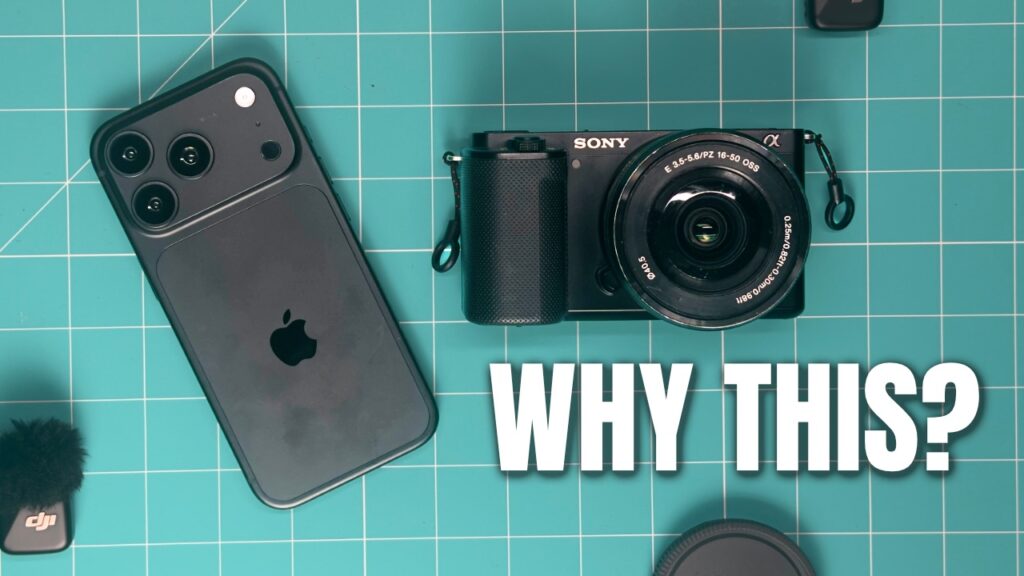
Instead, I much prefer using my Sony ZV-E10.
Which is quite interesting when I think about it, because I never actually bought the Sony to replace my iPhone.
So what changed?
Well, as it turns out, quite a lot. And not just the cameras.
When My iPhone Was My Entire Filming Setup
Back in 2019, I didn’t have the kind of filming setup I use today.
I had my iPhone 11, and for what I was trying to achieve, it worked really well.
I also used Filmic Pro, an app that gave me more manual control over things like focus and exposure. I enjoyed having that additional control because, even then, I wanted to experiment with how my footage looked.
Once I’d finished filming, I’d transfer everything to my iPad and edit using LumaFusion.
That was my workflow.
An iPhone for filming, an iPad for editing, and I could produce a complete YouTube video without needing a computer or a dedicated video camera.
And I genuinely enjoyed it.
I think that’s something worth remembering, particularly if you’re just starting out as a content creator.
It’s easy to look at established YouTubers and see their cameras, lenses, lighting and editing setups, and assume you need something similar to make good content.
But you really don’t.
My early videos might look very different from what I produce today, but that simple setup allowed me to start creating, learn new skills and work out what I actually enjoyed about making videos.
And that’s incredibly valuable.
The Limitations Started Appearing as My Ambitions Grew
As I became more experienced, I naturally started wanting to do more with my videos.
I was experimenting with different shots, filming more footage and becoming increasingly interested in how I could improve the overall look of my content.
And as my ambitions grew, so did my projects.
Now, there’s something you should know about me.
I’ve generally bought the base-storage versions of my iPhones and iPads.
My iPhone 11 had 64GB of storage, and so did my old 10.5-inch iPad Pro from 2017.
When I was making relatively small video projects, that wasn’t a major problem.
But as I started recording more footage and working on bigger edits, I found myself filling up those devices much more quickly.
Storage was becoming a genuine limitation.
It wasn’t that LumaFusion was suddenly incapable of editing my videos, or that the iPhone couldn’t produce good footage.
The issue was that the workflow I’d enjoyed when I started was becoming less convenient for the kind of projects I wanted to make.
And there’s an important distinction there.
Sometimes, the equipment you’re using isn’t necessarily holding back the quality of your work. It might simply be making the process of creating that work more difficult than it needs to be.
Would Things Have Been Different With Today’s Storage?
This is something I’ve wondered about while looking back at my early videos.
My current iPhone 17 Pro has 256GB of storage, compared with the 64GB in my iPhone 11.
Similarly, my M4 iPad Air has 128GB, compared with the 64GB in my old iPad Pro.
That’s a considerable difference.
Would I have continued filming and editing everything on my iPhone and iPad for longer if I’d had that additional storage when I first started?
Possibly.
I suppose I’ll never really know.
But it does highlight something important for anyone starting to make videos today.
The limitations I experienced in 2019 aren’t necessarily the same limitations you’ll encounter with a modern smartphone or tablet.
And even if storage becomes an issue, moving to a dedicated camera isn’t automatically the only solution.
Sometimes, changing how you store, transfer and manage your footage can make a significant difference.
For me, though, there were other changes happening at the same time.
I Didn’t Buy the Sony ZV-E10 to Replace My iPhone
Here’s the interesting part of this story.
When I bought my Sony ZV-E10 in November 2021, it wasn’t because I’d decided to stop filming on my iPhone.
I already owned a Sony a5000, which I used for photography, but it was starting to feel a bit outdated.
So I bought the ZV-E10 to replace it.
That was the original plan.
But around this time, I was also making more videos about iPhones.
And filming a video about an iPhone when that same iPhone is your main camera presents a slightly awkward problem.
How do you show the phone you’re talking about?
Of course, you can use screen recordings and find creative ways around it, but I wanted to be able to hold the phone, demonstrate features and film proper B-roll.
Suddenly, having another camera made that much easier.
So I started using the Sony to film my iPhone videos.
And the more I used it, the more I enjoyed the results.
It wasn’t an overnight switch. The Sony gradually became a bigger part of my filming setup.
Around this period, Filmic Pro also changed following its acquisition, including a move towards a subscription model. I wasn’t particularly enthusiastic about those changes, especially when I already had another camera I enjoyed using.
Meanwhile, my editing workflow was evolving too.
I moved away from editing everything on my iPad and started using DaVinci Resolve on my Mac.
Today, my Mac mini and MacBook Air both have 256GB of internal storage, but being able to work with external drives gives me more flexibility when managing larger video projects.
Looking back, the transition wasn’t really about replacing one piece of equipment.
My entire creative workflow was changing.
There’s Something About Sony Footage That I Prefer
This is probably the hardest part of my experience to put into words.
Because I can look at footage from my iPhone 17 Pro and genuinely appreciate how good it is.
But there’s still something about it that makes me think, that looks like it was filmed on an iPhone.
And I don’t necessarily mean that as a criticism.
To my eyes, iPhone footage often has a more immediate, raw quality to it.
Sometimes, that’s exactly what I want.
If I’m filming something spontaneously or capturing a moment without much preparation, that look can work brilliantly.
But when I’m producing one of my main YouTube videos, I tend to prefer the footage I get from the Sony ZV-E10.
There’s something about the overall image that feels more cinematic and polished to me.
Of course, this is a personal preference.
I’m not suggesting that an iPhone is incapable of producing cinematic footage, or that everybody would prefer the Sony’s image.
I’ve experimented with the Blackmagic Camera app, and I know there are ways to gain greater control over how an iPhone records video.
In fact, I’d be interested in exploring whether I could make my iPhone footage look closer to what I get from my Sony, using different recording settings and editing techniques.
That could be an interesting experiment for another day.
But there’s another reason I’ve grown so attached to the Sony, and it has very little to do with image quality.
I’ve Realised How Much I Enjoy the Process of Filmmaking
One thing I’ve discovered over the years is that I genuinely enjoy preparing to film.
Choosing a lens.
Putting my camera rig together.
Positioning the camera, adjusting the settings and getting everything looking how I want it.
Even physically pressing the record button.
I know those might sound like relatively small things, but they’re all part of the experience for me.
When I’m preparing to film a YouTube video, that process helps me get into the mindset of creating something.
It’s something I look forward to.
And although I can achieve a lot with my iPhone, I don’t get quite the same feeling from using it.
But that’s not a weakness of the iPhone.
In fact, one of its greatest strengths is that it removes much of that preparation.
You can take it out of your pocket, open the camera and start recording within seconds.
For some creators, that’s exactly what makes smartphone filmmaking so appealing.
For me, though, particularly when I’m working on a longer video, I enjoy the more deliberate experience of using a dedicated camera.
And I think we sometimes overlook that when discussing filmmaking equipment.
We spend so much time comparing specifications, features and image quality that we forget to ask a much simpler question.
Do I actually enjoy using this equipment?
Because if you enjoy the process of making videos, surely that’s worth considering too?
So Have I Actually Stopped Filming With My iPhone?
Not at all.
In fact, I still regularly use my iPhone 17 Pro, particularly when I’m creating dedicated YouTube Shorts or other short-form content.
I’ll also reach for my DJI Osmo Action 5 Pro when that makes more sense.
Both are convenient, capable and easy to use.
Sometimes, I just want to record something quickly without building a camera setup or thinking about which lens to use.
And that’s where those devices are brilliant.
But when I’m producing a longer video for COR Tech, I generally prefer working with the Sony.
I’ve reached a point where different cameras have different roles in my creative process.
And I’m perfectly happy with that.
Do You Actually Need to Upgrade From Your Smartphone?
If you’re reading this because you’re wondering whether it’s time to buy a dedicated camera for your own YouTube videos, I wouldn’t automatically recommend following the same path I did.
Instead, I’d think about what you’re trying to achieve and what’s currently getting in the way.
Are you struggling with storage? Perhaps a better way of managing your footage would help.
Do you want more control over your image? You might find that a different camera app, some experimentation with lighting or learning more about editing gets you closer to what you’re looking for.
Are you finding it difficult to film certain types of shots? That’s where a dedicated camera, another recording device or additional accessories might make a meaningful difference.
Or perhaps you’re simply curious about using a camera with interchangeable lenses and exploring a different approach to filmmaking.
That’s a perfectly good reason to experiment too.
But I wouldn’t upgrade simply because you feel that using a smartphone somehow makes you less of a content creator.
It doesn’t.
The equipment is there to help you create, not to determine whether your work is worth making.
My Camera Changed, but So Did I
When I look back at my early YouTube videos from 2019, I’m reminded of just how much has changed.
Not just the cameras, computers and software I use, but the way I approach making videos.
I’ve become more adventurous, more demanding of my own work and more interested in the creative process itself.
And as those things have changed, my equipment has evolved alongside them.
My iPhone has continued getting better, but I’ve discovered that, for the kind of videos I enjoy making, I prefer using my Sony ZV-E10.
Not because it’s necessarily the right choice for everyone.
But because it’s the right choice for me.
And perhaps that’s the most important thing I’ve learned.
The best camera for you isn’t always the one with the most impressive specifications. Sometimes, it’s the one that makes you want to go out and create something.
So whether you’re filming on an iPhone, a mirrorless camera or something else entirely, find a setup that works for you.
And more importantly, enjoy using it.
Because that’s what makes the whole creative process worthwhile.
I’ve also shared this journey in a video on COR Tech, including footage from my early iPhone videos and a closer look at the cameras I use today.
Watch the video: My iPhone Camera Got Better. So Why Did I Stop Using It?
What do you prefer filming with? A smartphone, a dedicated camera, or a combination of both? I’d be interested to hear how your own creative setup has changed over time.