
After years of running with my Garmin Fenix 7, Apple’s latest premium smartwatch has me seriously considering a return. But is the Apple Watch Ultra 4 actually worth switching to?
A few years ago, I made the decision to leave Apple Watch behind and switch to Garmin.
It wasn’t because I disliked Apple. Quite the opposite. I’ve been an Apple enthusiast for years, and I appreciated how well my Apple Watch worked alongside my iPhone and other devices.
The problem was battery life.
During a half marathon, my Apple Watch Series 7 almost ran out of battery despite being charged the night before. By the time I’d finished the race, around two hours and twenty minutes later, there was hardly anything left.
That experience raised an important question.
If I couldn’t trust my Apple Watch to comfortably last through a half marathon, how could I trust it to get me through a full marathon?
So I switched to Garmin.
Fast-forward a few years, and I’ve completed multiple marathons, covered thousands of kilometres and become incredibly comfortable with my Garmin Fenix 7.
But the arrival of the Apple Watch Ultra 4 has genuinely made me reconsider.
Could Apple finally have developed a watch capable of persuading me to leave Garmin?
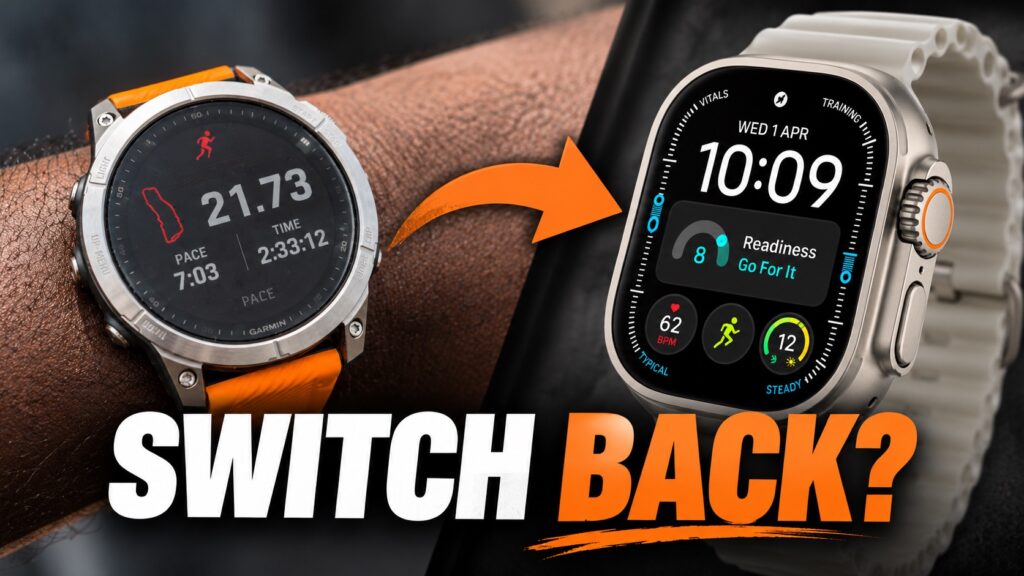
Why I’ve Stayed With the Garmin Fenix 7
There are three things I particularly appreciate about my Garmin: reliability, training statistics and battery life.
As a regular runner, I use Garmin Connect alongside applications such as Strava and Runna to track my activities and understand how my training is progressing.
Having access to information about recovery, training load and performance has become a valuable part of my routine.
But battery life remains Garmin’s biggest advantage for me.
My Fenix 7 generally provides more than ten days of battery life.
That means I can head out for a long run without worrying about whether I’ve charged my watch recently.
It’s a level of convenience that’s difficult to give up.
However, there is one area where my Fenix 7 is beginning to show its age.
The Garmin Fenix 7’s Display
My Fenix 7 uses a memory-in-pixel (MIP) display.
There are advantages to this technology, particularly outdoor visibility and battery efficiency.
But compared with the modern AMOLED displays appearing on newer premium smartwatches, it looks increasingly dated.
The Apple Watch Ultra 4 has a bright, colourful display that immediately appeals to the technology enthusiast in me.
While a better screen alone wouldn’t justify replacing my Garmin, it’s certainly part of the attraction.
Has Apple Finally Solved Its Battery Life Problem?
Battery life was the reason I originally left Apple Watch, so naturally, it’s one of the first things I considered when looking at the Ultra 4.
Apple advertises up to 50 hours of everyday use, with additional endurance available through its power-saving modes.
That’s still considerably less than the battery life I get from Garmin.
However, the Ultra 4 also offers faster charging.
And that’s made me reconsider how important having ten days of battery life actually is.
Do I really need a watch that lasts more than a week, or do I simply need one that doesn’t inconvenience me?
For example, if I could charge the Ultra 4 while having a shower and getting ready each morning, then comfortably wear it throughout the day and night, perhaps its shorter battery life wouldn’t be such a problem.
That’s something I’d need to experience firsthand.
But the possibility that battery life might no longer be a dealbreaker is one of the biggest reasons I’m interested in returning to Apple.
Apple’s New Heart-Rate Sensor Could Be a Big Deal for Me
One of the most interesting developments with the Apple Watch Ultra 4 is its redesigned heart-rate sensing system.
This is particularly relevant to my own running experience.
I’ve had difficulties with heart-rate tracking across several fitness watches.
On some occasions, watches have struggled to record my heart rate reliably during activities.
I’ve wondered whether my darker skin tone could be contributing to those problems, although factors such as movement, sensor positioning and fit can also affect optical heart-rate measurements.
It’s one of the reasons I currently use a separate COROS arm-based heart-rate monitor during my runs.
Apple’s redesigned sensor is therefore something I’m particularly interested in.
Could it finally provide the reliable readings I’ve been looking for?
I wouldn’t claim that without testing it myself, but it’s certainly a feature I’d want to investigate if I purchased the Ultra 4.
HRV and Readiness: Is Apple Catching Up With Garmin and WHOOP?
Apple is also developing its fitness and recovery features.
The Ultra 4 introduces more frequent heart-rate variability (HRV) measurements, alongside a new Readiness score.
HRV refers to the variation in time between heartbeats. Changes in those measurements can offer insights into how the body is responding to factors such as training, fatigue and recovery.
As someone who regularly uses Garmin’s training statistics, I’m particularly interested in how Apple interprets this information.
More measurements are useful, but what matters is whether they help me understand my recovery and make better training decisions.
Would Apple’s Readiness score reflect how I’m actually feeling?
Would it help me identify when I might need additional recovery?
And how would it compare with the information Garmin already provides?
These developments also raise an interesting question about Apple’s wider fitness ambitions.
Companies such as WHOOP have built their products around continuous health and recovery tracking. Garmin has also explored screenless wearables with its CIRQA Smart Band.
Could Apple eventually introduce something similar?
Perhaps an Apple Pulse or Apple Band, designed to deliver health and recovery information without a smartwatch display?
That’s purely speculation, but it’s an interesting possibility as Apple continues expanding its fitness capabilities.
Why the Apple Ecosystem Still Matters
Despite enjoying my Garmin, there are things I’ve missed about Apple Watch.
I use an iPhone, Mac and iPad, and I appreciate how seamlessly Apple’s devices work together.
It’s one of the reasons I’ve remained interested in returning.
I’m also keen to make greater use of Apple Health.
Although Garmin can share some information with Apple Health, the integration has limitations, particularly regarding detailed workout data.
An Apple Watch could provide a more integrated experience across the applications and devices I already use.
Why I’m Not Considering the Apple Watch Series 12
The Apple Watch Series 12 is undoubtedly a capable smartwatch.
But personally, coming from a Garmin Fenix 7, I think switching to the standard Apple Watch would feel like a downgrade in certain areas.
I’ve become accustomed to using a premium, outdoor-focused running watch.
If I’m going to return to Apple, I want something that feels like a meaningful upgrade.
For me, the Apple Watch Ultra 4 is the only Apple Watch I’d seriously consider as a replacement.
The Biggest Reason I Might Stay With Garmin: Safety
There’s one aspect of switching that I hadn’t initially considered.
Location sharing.
My wife and I both run. She uses a Samsung phone and Garmin watch, while I use an iPhone and my Fenix 7.
Garmin LiveTrack makes it relatively straightforward for us to follow each other’s progress when we’re running.
It’s reassuring during everyday training, but it’s particularly valuable during races.
When you’re trying to find someone among thousands of runners, having access to reliable live tracking can make an enormous difference.
And importantly, our arrangement works despite us using different smartphone ecosystems.
There are alternatives, including Strava Beacon and other cross-platform location-sharing applications.
However, I’d want to establish how reliably they work alongside my existing Runna and Strava setup before giving up Garmin LiveTrack.
I don’t want to complicate something that already works well.
If you use an Apple Watch while your partner or family uses Android, I’d be interested to know how you handle live location sharing during runs.
It’s one of the biggest unanswered questions in my potential switch.
Is the Apple Watch Ultra 4 Worth £749?
At £749, the Apple Watch Ultra 4 represents a considerable investment.
But there’s another way to look at the price.
If I decided to upgrade my Fenix 7 to a newer premium Garmin, I could potentially spend even more, depending on the model.
That makes Apple’s offering worth considering.
Of course, keeping my existing Garmin remains the most economical decision.
And that’s important because my Fenix 7 still does everything I need it to.
However, I’m genuinely tempted.
The improved battery performance, faster charging, modern display, redesigned heart-rate sensor and developing recovery features all make the Ultra 4 appealing.
Add Apple’s ecosystem integration, and there’s a strong argument for considering a return.
Would I immediately spend £749 on one?
Probably not.
But if the right mobile network contract came along, with a sensible overall cost, I could certainly see myself being persuaded.
So, Am I Ready to Leave Garmin?
For the first time in years, I’m seriously considering returning to Apple Watch.
That doesn’t mean I’ve made my decision.
I still appreciate everything my Garmin Fenix 7 offers, particularly its reliability, battery life and extensive training information.
There are also practical considerations, such as location sharing, that I’d need to resolve.
But the Apple Watch Ultra 4 has made me question whether the compromises that originally pushed me towards Garmin are still as important today.
Perhaps the Ultra 4 doesn’t need to outperform Garmin in every category.
Perhaps it simply needs to be a better smartwatch for my everyday life while remaining a sufficiently capable running watch.
And that’s what makes this potential switch so interesting.
Watch: Apple Watch Ultra 4 — Is It Time to Leave Garmin?
I’ve discussed my experience and the reasons I’m considering switching in my latest COR Tech video.
Watch the full video below:
I’d love to hear your thoughts.
Are you currently using Garmin or Apple Watch? Have you switched between the two?
And if you’ve found a reliable way to share live running locations between Apple Watch and Android users, let me know.